


What MCP Means for Your Dispensary, and the One Question Most Operators Forget to Ask

AI assistants are getting good at real work. The catch is they can only work with what they can reach. Your sales, loyalty, inventory, and customer history all live inside your retail platform. If your AI cannot get to that data, it cannot do much more than chat.
That is the problem MCP solves. You are going to hear the term a lot this year, so here is what it actually is and how to tell a real implementation from a checkbox.
What is MCP?
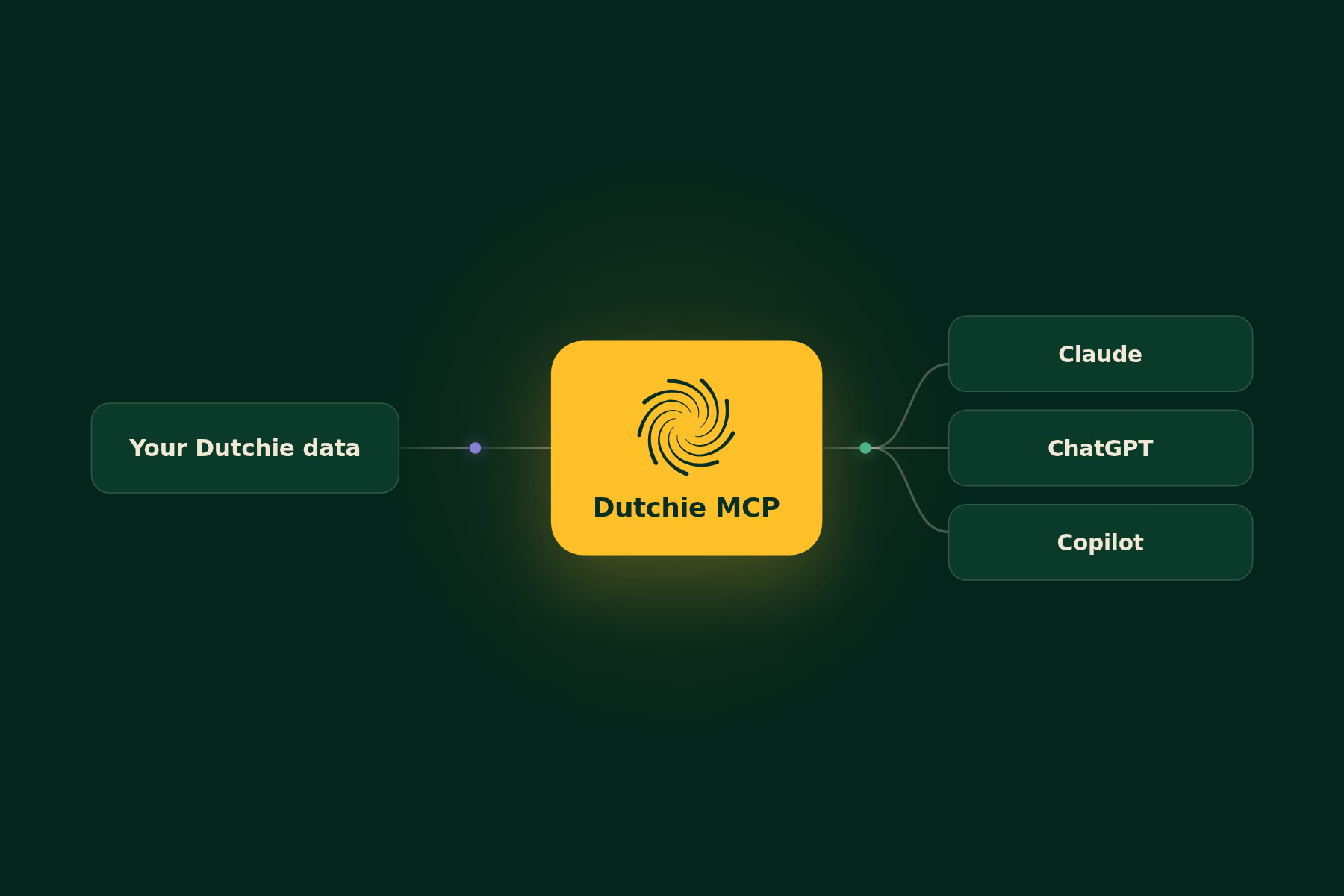
MCP stands for Model Context Protocol. It is an open standard that lets AI tools connect to software platforms and work with the data inside them. Think of it as a universal connector. Before MCP, every AI tool needed a custom integration with every platform it wanted to touch. With MCP, any AI assistant that speaks the standard can connect to any platform that supports it.
Practically, it means you can point the AI tools you already use at your own business data and ask questions like:
Which products have sat on my shelf for 60 days, and which lapsed customers used to buy them?
Which locations underperformed their trailing average last week, and by how much?
What does my discounting look like by employee, and does anything look off?
Those are not dashboard questions. They are analysis questions. They require pulling from several parts of your business at once, lining the data up, and doing math across it.
MCP also changes who gets to do this. Connecting an AI tool to your platform used to mean hiring someone, scoping an integration, and maintaining it. Because MCP is a standard, connecting is setup, not a development project.
Not all MCP is built the same
Here is the part most vendor announcements skip. There are two ways to build an MCP connection, and the difference decides whether your AI can do real analytical work or just look things up.
Take a question plenty of operators want answered: which employees are discounting well above the rest of the staff? Answering it means pulling transactions for every employee, calculating each discount rate, comparing those against the store average, and separating legitimate loyalty adjustments from everything else. How the connection is built decides whether your AI can do that at all.
Everything through the model
Every capability is a separate tool. The AI calls one, reads the result, decides what to call next.
Models can fire several calls at once, but every result has to pass back through the model's context window first. Ask that question and every raw transaction pull lands in context. Context is finite. As it fills, accuracy degrades, details buried mid-context get overlooked, and eventually there is no room left for the analysis itself.
The task that mattered most is the task that fails.
Code mode
The AI writes a small program that runs the whole analysis in one pass, inside a secure, walled-off environment, and returns only the answer.
Same question, code mode: one script pulls every employee's transactions, computes discount rates against the store average, checks loyalty adjustments, cross-references voids against shrinkage, and hands back a short list worth a closer look. Hundreds of operations, one pass, one clean answer.
The math is computed, not eyeballed.
Cloudflare coined the term "code mode" for this approach to MCP. Anthropic, the maker of Claude, published an example of it in practice: a workflow that consumed roughly 150,000 units of AI processing ran in about 2,000 when the model wrote code instead. One example, not a benchmark.
Efficiency is the smaller win. The real win is that whole categories of work become possible.
| You ask | MCP without code mode | MCP with code mode |
|---|---|---|
| "Which employees have unusually high loyalty balances built up over the past year?" | Not really answerable. Flagging a pattern across thousands of accounts by hand isn't realistic. | You get the handful of accounts worth investigating, not the raw ledger. |
| "Audit margin integrity across all 8,500 SKUs in my catalog." | Can't be done. Pulling cost and pricing data for 8,500 SKUs through a conversation isn't feasible. | You get the SKUs with a margin problem, not the full catalog. |
| "Give me five years of sales history and tell me what's actually changed." | Same ceiling. Five years of transaction data can't move through raw tool calls. | You get the handful of data points that matter. |
| "Find where my online menu and my actual inventory have drifted apart, and tell me why." | You get inventory data and menu data separately. Spotting the drift is still on you. | You get the specific gaps and the likely cause. |
| "Reconcile payments across every provider I use, for the full year." | You get per-provider transaction data. Reconciling across providers and a year is still on you. | You get the discrepancies, not three separate exports. |
A typical MCP tool call hands back one piece of data at a time. With code mode, it hands back the specific answer, already worked out and ready to act on.
Lookups become investigations.
The question most operators forget to ask
An AI connection is only as useful as the data behind it. If your transactions live in one system, your loyalty in a second, your e-commerce in a third, and your inventory in a fourth, then even a perfect MCP connection to any one of them sees a slice of your business. The employee discount analysis only works because transactions, discounts, loyalty, and inventory share one platform. Split those across four vendors and your AI cannot make that connection at all. So before anything else, ask: how much of my business can this connection actually see?
It is easy to evaluate an MCP connection feature by feature and miss the real ceiling: how much of your business actually sits behind it. Every system you consolidate is another part of your business your AI can analyze.
Security: what good looks like, and what to demand next
Connecting AI to your business data deserves the same scrutiny as any integration, and a little more.
Table stakes today
See exactly what is connected. Limit what it can reach. Shut off access instantly, and know where your data goes when an AI reads it.
What to demand as these mature
Individual user sign-in. Role-based permissions, so a budtender's AI cannot see what an owner's can. Approval steps before an AI acts instead of just reads.
That last one matters most. Reading data is where MCP starts. Taking action, adjusting a price, launching a campaign, is where it is going, and actions need guardrails that lookups do not.
Code mode makes that worth pressing on: if the AI is writing and running code, what exactly are you approving? Approving a discrete "adjust this price" call is legible. Approving a block of generated code is not. Look for a sandbox that gates the individual operations the code performs rather than treating the whole script as one approval, and make sure anything that changes your business is kept separate from anything that only looks at it.
Questions to ask any vendor claiming MCP support
How much of the platform does it cover? If your AI can only see a slice, it can only answer slice-sized questions.
Is it code mode, or does everything route through the model? Now you know why this matters. If they cannot answer, that tells you something too.
What does it cost? Ask what access to your own data costs, and whether that changes as usage grows.
Who owns the data, and where does it go? Ask who retains ownership, whether the vendor has ever sold customer data, and what happens to data that flows through an AI connection.
What does setup actually take? If the answer involves a services engagement or a custom build, that is not really MCP working for you.
How is access controlled? Ask whether people sign in as themselves, whether permissions follow their role, and how you revoke access the day someone leaves.
What happens as I add products? Ask what your AI could analyze across the vendor's full product line versus what it sees today.
Where Dutchie stands
Dutchie supports MCP with code mode, at no charge, covering the platform. Not a separate product, not an upsell. It is a feature of an open ecosystem, the same way our 100+ integrations and API partners are. You already own your data. Dutchie has never sold customer data.
And because Dutchie is a unified platform, there is more for your AI to work with. Point of sale, E-Commerce, payments, loyalty, and inventory share a single data layer. When your AI asks a question that spans all of them, the answer is one query away, not four vendors away.
Your data is the most valuable asset in your business, and AI is the first tool that can put all of it to work at once. Make sure the connection is built for it.


